Trastuzumab deruxtecan, also known as DS-8201 or T-DXd, has become an important HER2-directed antibody-drug conjugate for HER2-expressing solid tumors. As ADC programs continue to expand, acquired resistance has become a practical question for payload selection, follow-on ADC design, biomarker interpretation, and combination strategy.
In this case study, we examine an NCI-N87/DS-8201-resistant gastric cancer model generated by in vitro drug-induced resistance. The model shows markedly reduced response to DS-8201, while HER2 expression is not obviously lost. This creates a useful setting for asking whether resistance is driven by target expression alone, or whether additional payload-linked and intracellular mechanisms should be considered.
The data illustrate a stepwise interpretation framework: first confirming the resistant phenotype, then comparing cross-resistance across ADCs and payloads, and finally using HER2 detection, RNA-seq, WES, bioinformatics analysis, and orthogonal validation to build a more mechanism-focused resistance hypothesis.
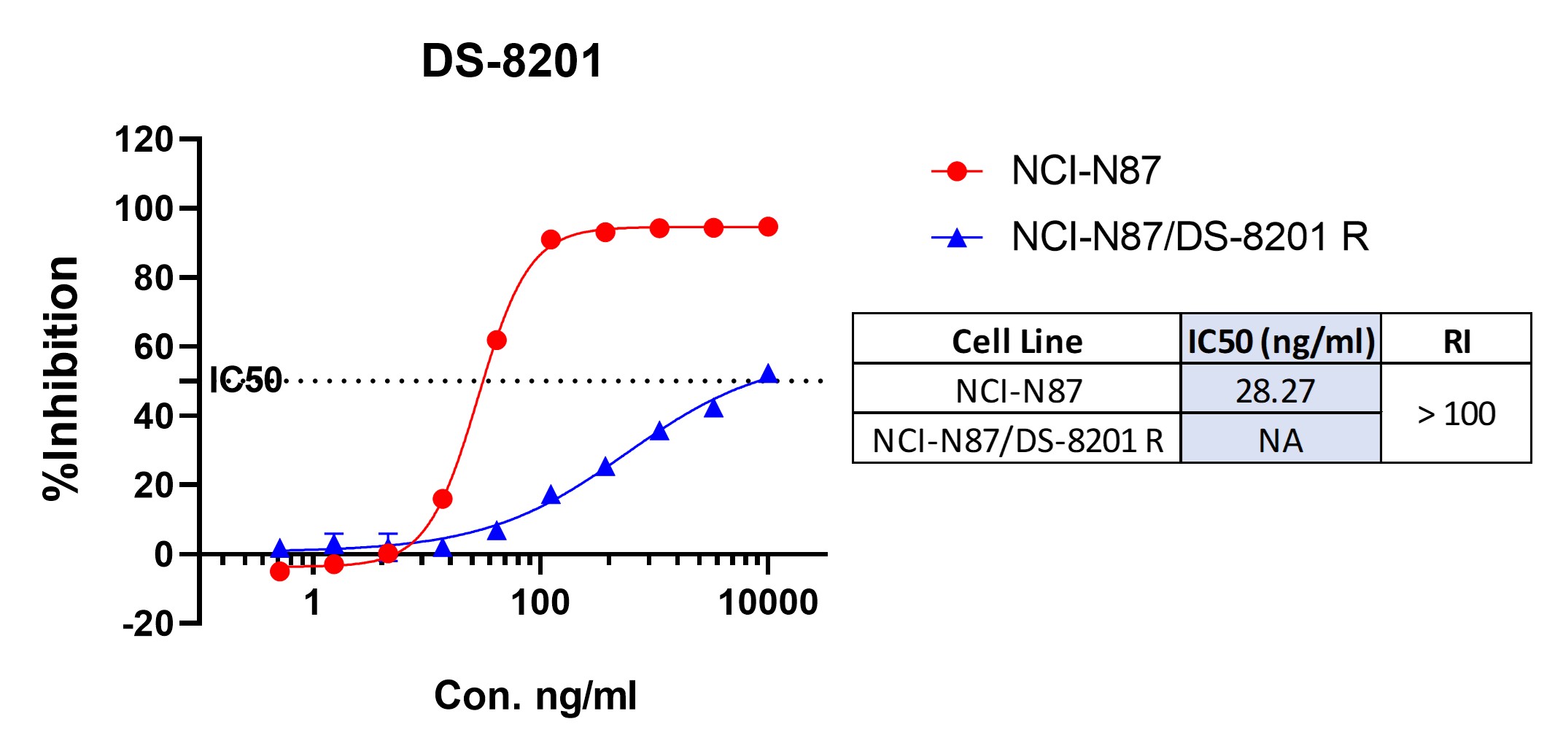
The parental NCI-N87 gastric cancer cell line showed a clear concentration-dependent response to DS-8201. After drug-induced resistance generation, the resulting NCI-N87/DS-8201 R model showed a substantial loss of sensitivity, with the DS-8201 response shifted beyond the tested concentration range and a resistance index greater than 100.
This first layer establishes the model as a resistant phenotype, but it does not explain the mechanism. For ADC resistance studies, this distinction is important. A strong resistance index provides the entry point for interpretation, while the next question is whether the phenotype reflects target loss, altered payload response, intracellular processing changes, efflux, DNA damage response rewiring, or a combination of these mechanisms.
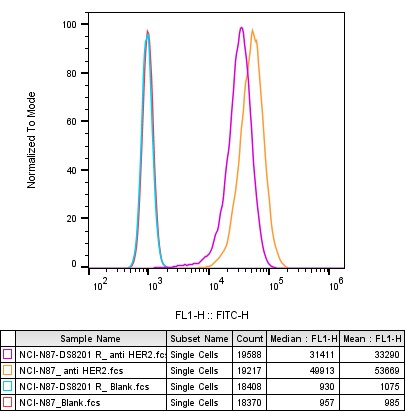
A common first hypothesis for HER2 ADC resistance is reduced HER2 expression. In this model, however, HER2 detection did not show an obvious loss of HER2 expression. This makes the case more informative, because it suggests that resistance cannot be interpreted simply as loss of the ADC-binding antigen.
For DS-8201, maintained HER2 expression means that later steps in the ADC process become more important to examine. These may include ADC internalization, lysosomal processing, payload release, intracellular payload exposure, topoisomerase I-related response, DNA damage repair capacity, survival pathway rewiring, and drug efflux.
In this context, HER2 detection serves as a useful exclusionary layer. It does not prove the downstream mechanism, but it helps redirect the analysis away from a single target-loss explanation and toward a broader payload- and cell-state-focused interpretation.
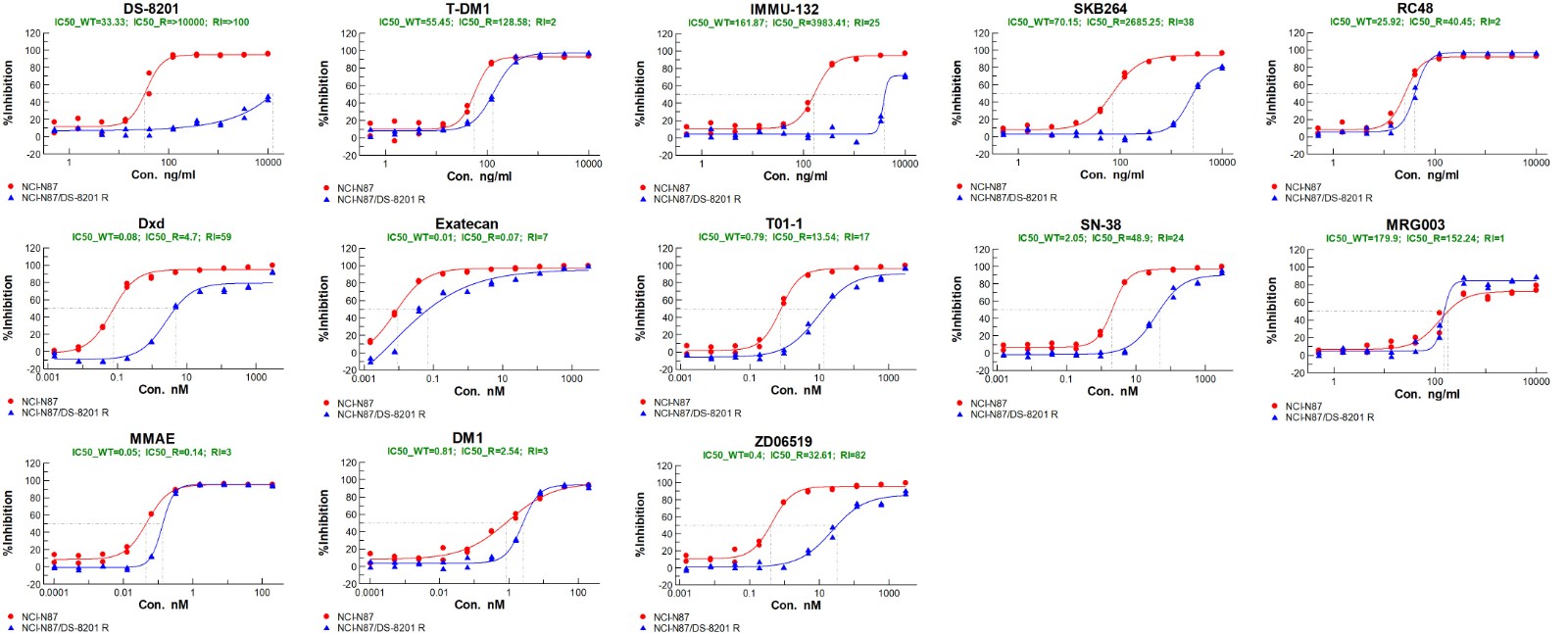
To further interpret the resistant phenotype, the NCI-N87/DS-8201 R model was tested against a panel of ADCs and free payloads. This cross-resistance layer is useful because ADC resistance may be driven by antibody/target biology, payload response, or mechanisms that affect both.
In this model, resistance was not limited to the original HER2-directed ADC. The NCI-N87/DS-8201 R cells also showed resistance shifts to several topoisomerase I inhibitor payload-related agents, including the free payloads Dxd, SN-38, T01-1, and ZD06519, as well as selected TROP2 ADCs such as IMMU-132 and SKB264.
This does not mean that HER2 and TROP2 target biology are equivalent. Rather, it suggests that once the payload is released intracellularly, the resistant cells may have reduced sensitivity to related Topo I inhibitor payload stress. By comparison, tubulin inhibitor payload-related agents, including T-DM1, RC48, MMAE, and DM1, showed lower-level shifts in this model.
| Agent | Format | Target / Payload Class | IC50 WT | IC50 Resistant | RI | Interpretation |
|---|---|---|---|---|---|---|
| ADCs with topoisomerase I inhibitor payload biology | ||||||
| DS-8201 | HER2 ADC | HER2 / Dxd, Topo I inhibitor | 33.33 ng/mL | >10000 ng/mL | >100 | Inducing ADC; strong acquired resistance |
| IMMU-132 | TROP2 ADC | TROP2 / SN-38, Topo I inhibitor | 161.87 ng/mL | 3983.41 ng/mL | 25 | Cross-resistance to another Topo I payload ADC |
| SKB264 | TROP2 ADC | TROP2 / Topo I inhibitor payload | 70.15 ng/mL | 2685.25 ng/mL | 38 | Pronounced cross-resistance to Topo I payload ADC |
| Free topoisomerase I inhibitor payloads | ||||||
| Dxd | Free payload | Topoisomerase I inhibitor | 0.08 nM | 4.7 nM | 59 | Strong payload-level cross-resistance |
| Exatecan | Free payload | Topoisomerase I inhibitor | 0.01 nM | 0.07 nM | 7 | Moderate payload-level shift |
| T01-1 | Free payload | Topoisomerase I inhibitor | 0.79 nM | 13.54 nM | 17 | Clear payload-level cross-resistance |
| SN-38 | Free payload | Topoisomerase I inhibitor | 2.05 nM | 48.9 nM | 24 | Clear payload-level cross-resistance |
| ZD06519 | Free payload | Topoisomerase I inhibitor | 0.4 nM | 32.61 nM | 82 | Strong payload-level cross-resistance |
| Tubulin inhibitor payload-related agents | ||||||
| T-DM1 | HER2 ADC | HER2 / DM1, tubulin inhibitor | 55.45 ng/mL | 128.58 ng/mL | 2 | Lower-level shift compared with Topo I agents |
| RC48 | HER2 ADC | HER2 / MMAE, tubulin inhibitor | 25.92 ng/mL | 40.45 ng/mL | 2 | Lower-level shift compared with Topo I agents |
| MMAE | Free payload | Tubulin inhibitor | 0.05 nM | 0.14 nM | 3 | Lower-level payload shift |
| DM1 | Free payload | Tubulin inhibitor | 0.81 nM | 2.54 nM | 3 | Lower-level payload shift |
| Other ADC | ||||||
| MRG003 | EGFR ADC | EGFR ADC | 179.9 ng/mL | 152.24 ng/mL | 1 | No clear resistance shift in this model |
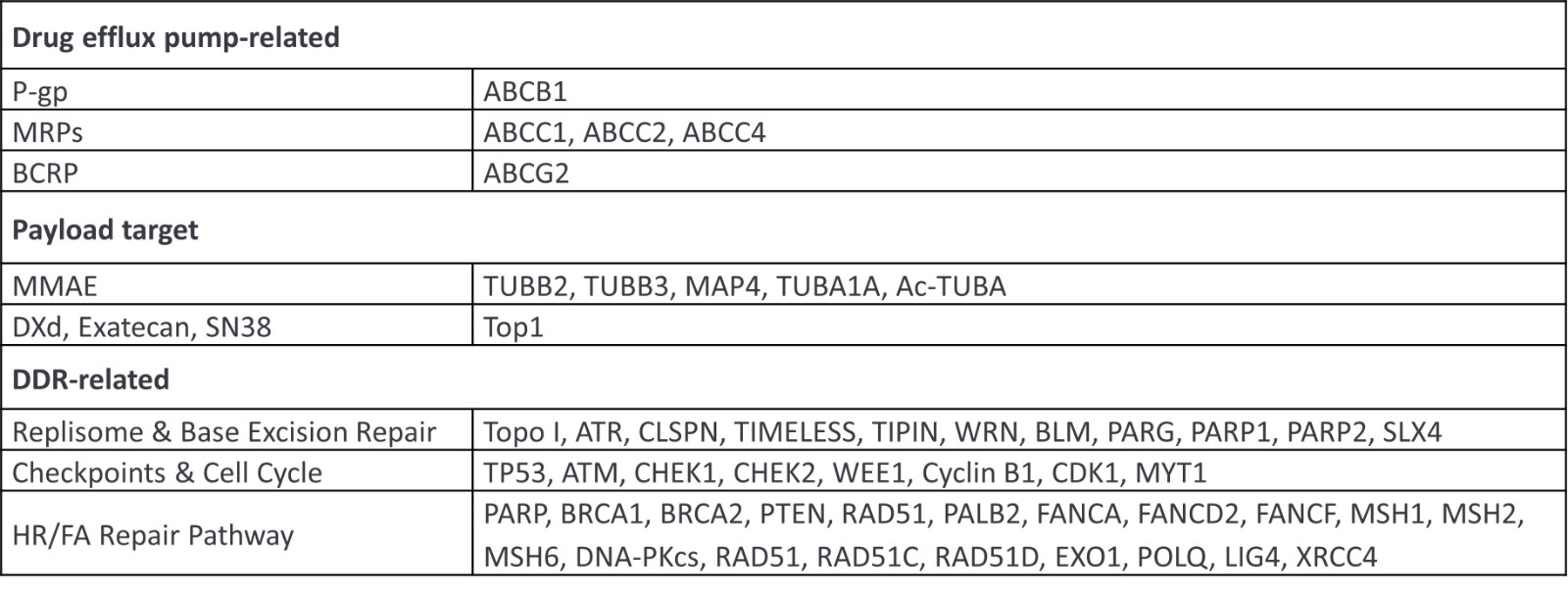
After cross-resistance profiling, the key question becomes how to interpret the payload-linked resistance pattern. Rather than treating RNA-seq and WES as broad exploratory datasets, the analysis was organized around mechanism categories directly relevant to ADC and payload resistance.
For a DS-8201-resistant model, this focused framework is particularly important because the payload component, Dxd, is a topoisomerase I inhibitor. Therefore, resistance interpretation should consider not only ADC target expression, but also genes and pathways involved in intracellular payload exposure, payload target biology, DNA damage response, checkpoint regulation, cell-cycle control, and DNA repair.
The bioinformatics checklist grouped candidate resistance mechanisms into several practical categories, including drug efflux pump-related genes, payload target-associated genes, replisome and base excision repair, checkpoint and cell-cycle regulation, HR/FA repair pathways, and ADC target-related genes. This structure helps connect the phenotypic data with biologically testable hypotheses.
In this case, the checklist provides the rationale for looking beyond HER2 expression alone. It supports a more systematic evaluation of whether DS-8201 resistance may involve reduced payload exposure, altered response to topoisomerase I inhibitor stress, enhanced DNA damage tolerance, or broader cell-state adaptation.
RNA-seq analysis then provided a broader view of the resistant cell state. The expression heatmap was organized around resistance-relevant gene categories, including drug efflux pump-related genes, payload target-associated genes, replisome and base excision repair, checkpoint and cell-cycle regulation, HR/FA repair pathways, and ADC target-related genes.
One of the most direct signals was the upregulation of efflux-related genes, particularly ABCG2. This aligns with the cross-resistance pattern observed across several topoisomerase I inhibitor payloads and related ADCs, suggesting that altered intracellular payload exposure may be one contributor to DS-8201 resistance.
At the same time, the RNA-seq results also point to additional resistance-associated changes. Differential expression of checkpoint and cell-cycle genes such as WEE1 and MYT1, together with changes in HR/FA repair pathway genes such as FANCF and XRCC4, suggests that the resistant phenotype may involve broader adaptation to payload-induced DNA damage rather than efflux alone.
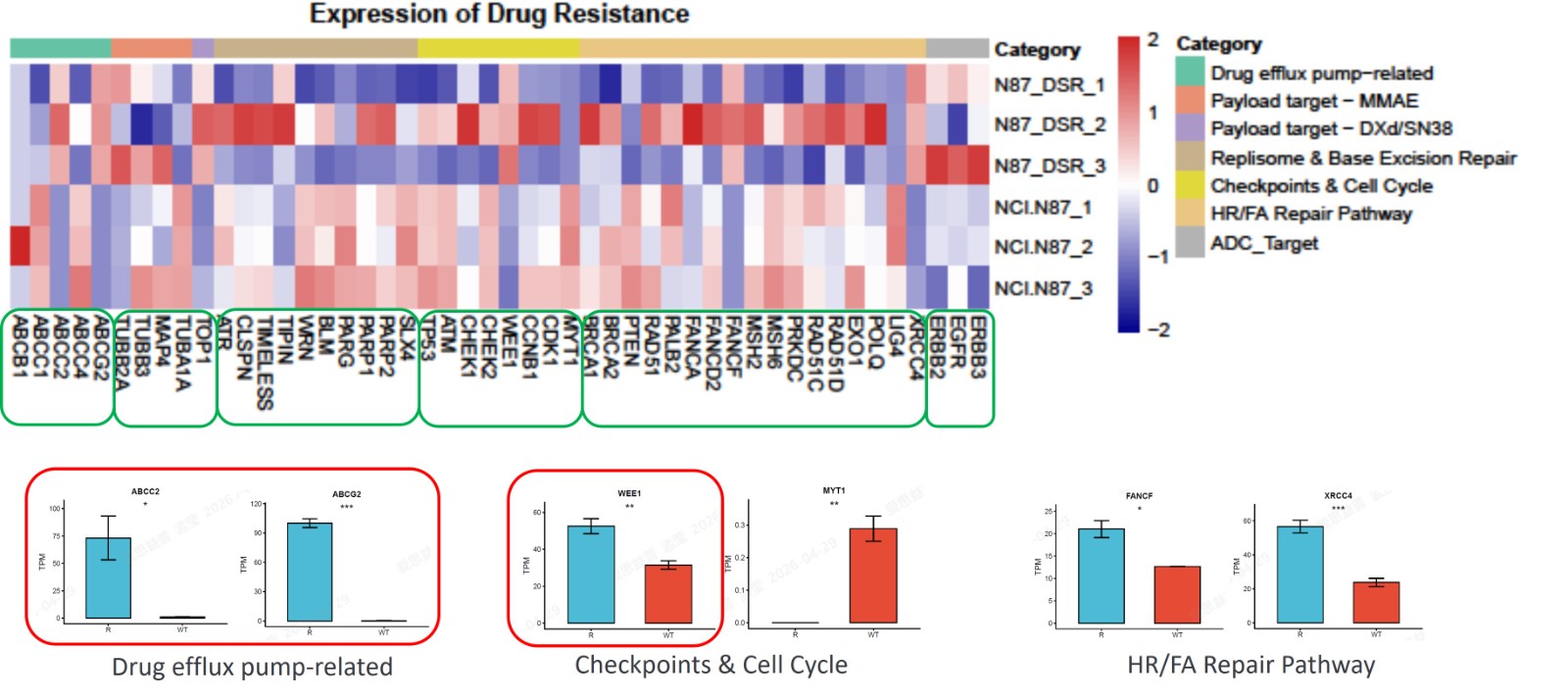
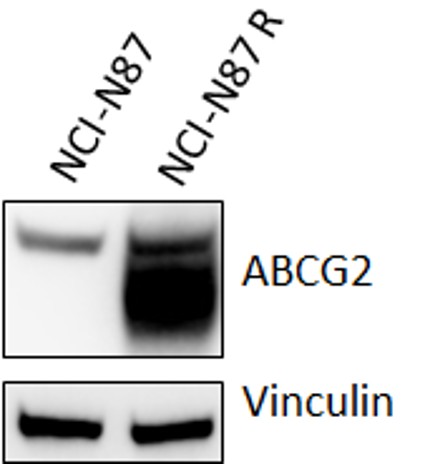
Taken together, the NCI-N87/DS-8201 R model does not support a simple target-loss explanation. HER2 expression was not obviously lost, while the resistant cells showed strong DS-8201 resistance, cross-resistance to several topoisomerase I inhibitor payload-related agents, ABCG2 upregulation, and transcriptomic changes in cell-cycle checkpoint and DNA repair-associated pathways.
A more appropriate interpretation is therefore a multi-axis resistance model. In this model, transporter-associated efflux may reduce intracellular payload exposure, while checkpoint and repair pathway changes may help resistant cells tolerate the DNA damage stress caused by topoisomerase I inhibitor payloads.
This distinction matters for ADC discovery. If resistance is interpreted only through HER2 expression, important payload-linked liabilities may be missed. If it is interpreted only through ABCG2, broader cell-state adaptation may also be overlooked. A combined phenotypic, cross-resistance, transcriptomic, and protein-validation workflow provides a more useful basis for selecting follow-up experiments and evaluating resistance-overcoming strategies.
In this DS-8201-resistant NCI-N87 case study, resistance cannot be fully explained by obvious HER2 loss. The model instead supports a broader interpretation in which payload-linked response, ABC transporter-associated changes, and downstream DNA damage response-related adaptation should be evaluated together.
For ADC discovery, this type of resistant model provides more than a potency comparison. It creates a practical framework for connecting acquired resistance phenotype with mechanistic hypotheses that can guide follow-up validation, payload strategy, and combination evaluation.
2026-08-20
2026-07-03
2026-05-22
2026-05-13
We value your inquiries and are here to provide you with tailored solutions for your drug discovery and development needs. Whether you have questions, require more information, or are interested in discussing potential collaborations, our team of experts is just a message away.
Feel free to reach out to us.

Address: Bldg 16, Yd 18, Kechuang 13th St, Etown, Tongzhou Dist, Beijing, 100176, China
Email: marketing@ice-biosci.com
Tel:+86-10-67809840


Get a quote

Go top