
GPCRs (G protein-coupled receptors) are a pivotal class of seven-transmembrane receptors, with more than 800 family members that regulate diverse physiological signaling pathways. Their central biological roles make them important therapeutic targets across many disease areas.
ICE Bioscience provides ready-to-use assays for more than 190 GPCR targets across human and preclinical species, with continued expansion to meet evolving discovery needs.
Coverage includes human targets and selected mouse, rat, dog, monkey and rabbit variants.
| Aminergic & Peptide | Chemokine & Immune | Metabolic & Other Targets |
|---|---|---|
| 5-HT1A, 5-HT1B, 5-HT1F, 5-HT2A, 5-HT2B, 5-HT2C, 5-HT4A, 5-HT4B, 5-HT5A, 5-HT7A, 5-HT7B | CCR1, CCR2, CCR4, CCR5, CCR6, CCR7, CCR8, CCR9A, CCR9B, CXCR1, CXCR2, CXCR4 | GLP-1R, GLP-2R, GIPR, GCGR and selected mouse, rat, dog, monkey and rabbit variants |
| D1, D2L, D2S, D3, D4, D5, Alpha 1A, Alpha 1B, Alpha 1D, Alpha 2A, Alpha 2B, Alpha 2C, Beta 1, Beta 2 | FPR1, FPR2, C3aR1, C5aR1, MRGPRX1, MRGPRX2, MRGPRB2, Dog and Monkey MRGPRX2 | hCTR, Rat CTR, Dog CTR, Monkey CTR; hAMY1, hAMY2, hAMY3, Rat AMY1, Rat AMY3, Dog AMY3, Monkey AMY3 |
| M1, M2, M3, M4, M5; MT1, MT2; H1, H2, H3; A1, A2A, A2B | S1P1, S1P2, S1P3; LPA1, LPA3; PAR1, PAR2, PAR4; ETA, ETB, Rat ETB, Mouse ETB, Dog ETB | hCGRP1, hAM1, hAM2, TGR5, CASR, FFAR3 (GPR41), GPR40, GPR35, GPR75, GPR84 |
| DOR, KOR, MOR, Rat MOR, Mouse MOR, NOP, Rat NOP, Mouse NOP; NK1, Rat NK1, NK2, Mouse NK2, Rat NK2, NK3 and variants | APJ, AT1, AT2, BDKRB1, BDKRB2, OXTR, Rat OXTR, OX1, OX2, V1a, V1b, V2, NPY2R | MC1, MC4, MC5, PTH1R, IP, TP, FP, EP1, EP2, EP3, EP4 and selected rat or mouse variants |
| P2Y1, P2Y2, P2Y6, P2Y12; SSTR1, SSTR2, SSTR3, SSTR4, SSTR5; mGlu2, mGlu7 | GPR3, GPR6, GPR12, GPR17-S, GPR17-L, hGPR52 and mouse, rat, monkey and dog GPR52 variants | BB1, BB2, BB3, CB1, CB2, CCK1, CCK2, GnRH and selected mouse, rat and rabbit variants; TAAR1 |
190+ GPCR targets spanning human and selected preclinical species variants.
Binding and functional assays for agonist, antagonist and PAM programs.
Custom cell-line development, single-dose screening or EC50 and IC50 dose-response studies.
Rapid screening programs with typical turnaround times of 1–2 weeks.
Our GPCR panel solutions support early assessment of efficacy, potency, selectivity and safety. Programs can include specialized GPCR panels, safety panels ↗, and custom testing configurations.
SPR, spectral shift and TRIC. Real-time SPR on Biacore 8K can be combined with Dianthus Spectral Shift and TRIC technologies for kinetic characterization and high-throughput binding studies.
Direct ligand–receptor measurement. Radioligand binding assays provide sensitive and precise measurement of ligand–receptor interactions.
Cell-surface receptor binding. Fluorescent ligands or antibodies can be used to detect and quantify GPCR binding on cells.
Competitive affinity profiling. Tag-Lite operates in a competitive binding format, using the resulting signal change to quantify binding affinity.
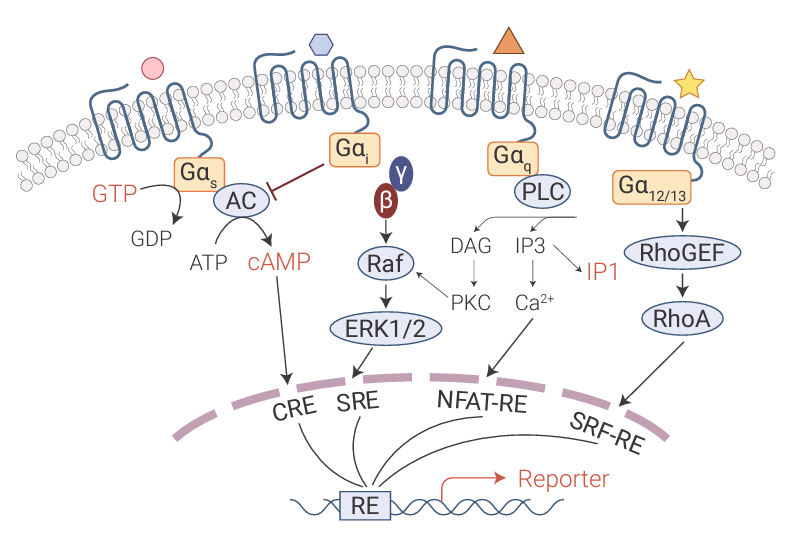
G protein and second-messenger signaling. cAMP assays for Gs/Gi-coupled receptors; IP1 and calcium-flux assays for Gq-associated signaling; and direct GTPγS binding assays for G-protein activation.
Pathway and recruitment readouts. Reporter-gene assays, β-arrestin recruitment assays, and pERK/pAKT In-Cell Western assays support pathway-specific profiling.
Cellular response assays. Receptor internalization by high-content imaging and chemotaxis assays provide complementary cellular-response measurements.
We value your inquiries and are here to provide you with tailored solutions for your drug discovery and development needs. Whether you have questions, require more information, or are interested in discussing potential collaborations, our team of experts is just a message away.
Feel free to reach out to us.

Address: Bldg 16, Yd 18, Kechuang 13th St, Etown, Tongzhou Dist, Beijing, 100176, China
Email: marketing@ice-biosci.com
Tel:+86-10-67809840


Get a quote

Go top