
Antibody-Drug Conjugates (ADCs) represent one of the most promising modalities in modern oncology. However, their complex mechanism of action—combining target binding, internalization, lysosomal processing, payload release, and bystander effects—cannot be fully captured by in vitro assays alone.
Cell Line-Derived Xenograft (CDX) models are generated by implanting well-characterized human tumor cell lines into immunocompromised mice. While Patient-Derived Xenograft (PDX) models offer high clinical relevance, CDX models offer distinct advantages that make them particularly well-suited for ADC drug discovery and early-stage development.
✅ Controlled Antigen Expression — Cell lines can be pre-screened and selected for high, medium, or low antigen expression, enabling direct correlation between target density and ADC efficacy.
✅ Rich Molecular Characterization — Well-defined genetic backgrounds facilitate mechanistic interpretation and biomarker discovery.
✅ Rapid Tumor Establishment — Faster tumor formation compared with PDX models, accelerating your screening timeline.
✅ High Reproducibility — Genetically homogeneous cell populations ensure statistically robust data for efficacy and toxicity studies.
✅ Extensive Library & Scalability — Access a diverse catalog of models that balance scientific rigor with budget efficiency for high-throughput screening.
✅ Drug Resistant Models Availability — Beyond conventional CDX models, ADC-resistant xenograft models are available to support next-gen ADC optimization and resistance mechanism research.
At ICE Bioscience, we've built a comprehensive portfolio of ADC-focused CDX models spanning multiple cancer indications and targeting key antigens including HER2, TROP-2, Nectin-4, and TOP1.
Whether you're optimizing payload selection, evaluating combination strategies, or investigating resistance pathways, our validated ADC CDX platform is designed to deliver actionable insights and accelerate your path to IND.
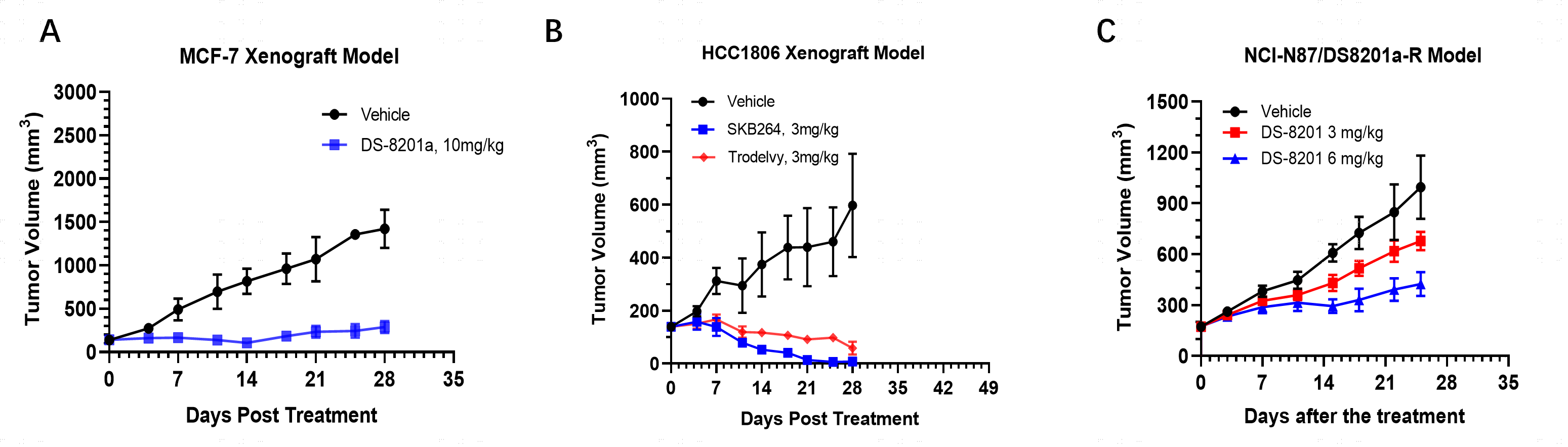
Figure: ADC efficacy evaluation in different CDX models. (A) MCF-7 Xenograft Model (HER2); (B) HCC1806 Xenograft Model (TROP-2); (C) NCI-N87/DS-8201a-R Model (HER2 Acquired Resistance)
We value your inquiries and are here to provide you with tailored solutions for your drug discovery and development needs. Whether you have questions, require more information, or are interested in discussing potential collaborations, our team of experts is just a message away.
Feel free to reach out to us.

Address: Bldg 16, Yd 18, Kechuang 13th St, Etown, Tongzhou Dist, Beijing, 100176, China
Email: marketing@ice-biosci.com
Tel:+86-10-67809840


Get a quote

Go top