
Carcinogenicity assessment is not a single experiment or a single animal study. It is an integrated scientific process for determining whether a pharmaceutical may increase cancer risk in humans—and what evidence is needed to resolve that question.
Cancer-related safety findings are among the most consequential liabilities in pharmaceutical development. Depending on the nature, strength, and clinical relevance of the evidence, they may influence development strategy, product labeling, patient selection, clinical monitoring, or the overall benefit–risk assessment of a medicine.
In the United States, the formal regulatory term is Boxed Warning, although “black-box warning” is still commonly used in non-regulatory language. A Boxed Warning is prominently placed at the beginning of the prescribing information and may describe serious adverse reactions that can lead to death or serious injury.1 It is important, however, not to equate every animal tumor finding with a Boxed Warning. Regulatory consequences depend on the totality of evidence, including mechanism, exposure, human relevance, clinical context, and available risk-management measures.
Carcinogenic risk is also not synonymous with genotoxicity. Cancer may arise through direct genetic damage, but pharmaceuticals can also influence tumor development through persistent hormonal perturbation, immune suppression, altered cell growth or survival, chronic inflammation, repeated tissue injury and regeneration, or unintended pharmacological activity.
Which pharmaceuticals need carcinogenicity assessment?
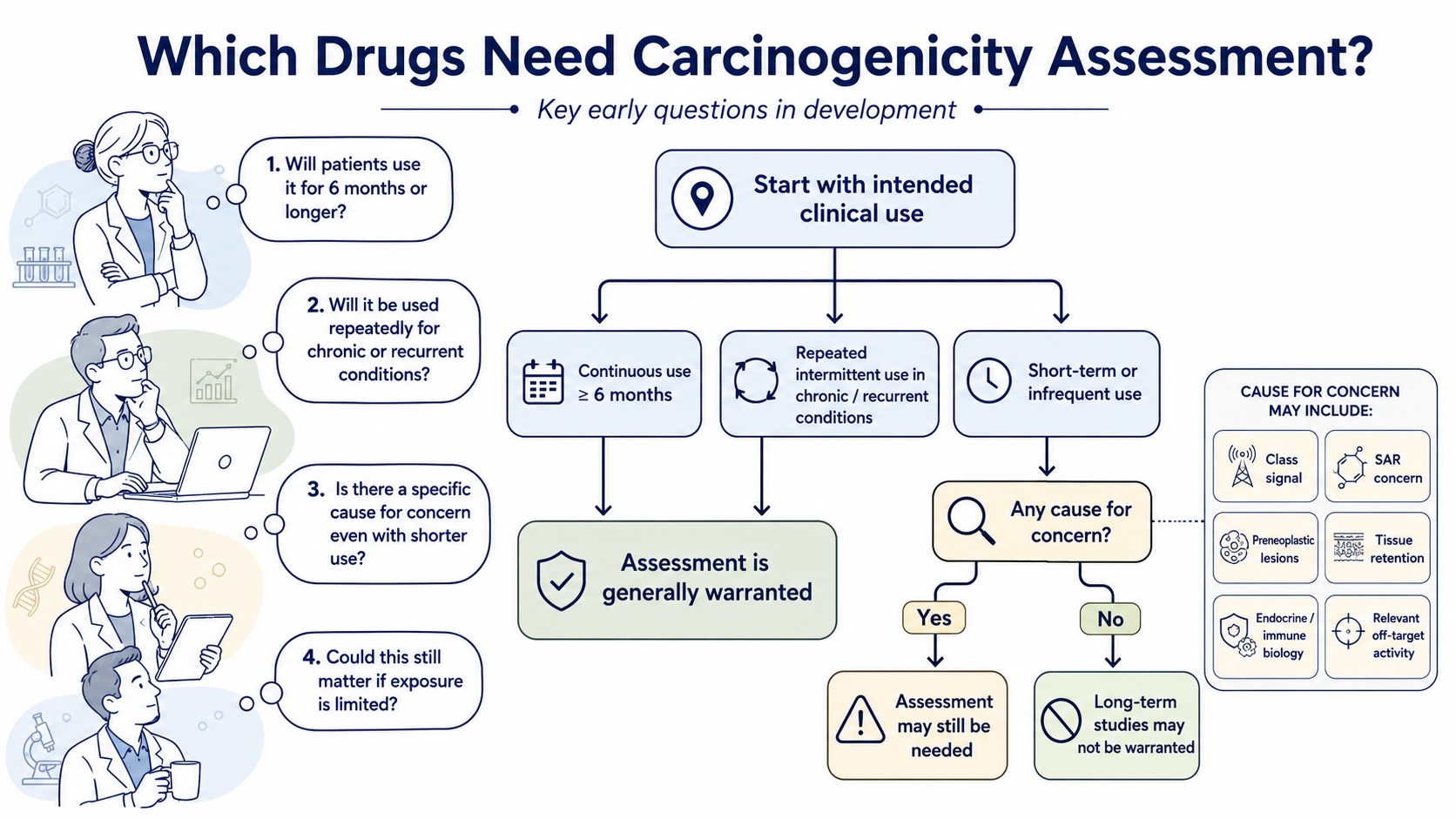
ICH S1A defines the main factors that determine whether carcinogenicity studies are warranted. The decision depends primarily on expected clinical exposure and any existing cause for concern, rather than on a single rigid development milestone.2
Pharmaceuticals intended for continuous use for at least six months
Carcinogenicity studies are generally expected for pharmaceuticals whose intended clinical use is continuous for six months or longer. This commonly includes treatments for chronic metabolic, cardiovascular, neurological, psychiatric, inflammatory, endocrine, and other long-term conditions.
The six-month threshold should not be interpreted as meaning that a compound suddenly becomes a concern on the first day of month seven. It is a regulatory framework for identifying therapies for which prolonged human exposure makes information from lifetime animal studies potentially relevant.
Pharmaceuticals used repeatedly for chronic or recurrent conditions
A medicine may be used in individual courses shorter than six months but still result in substantial cumulative exposure. ICH S1A therefore states that pharmaceuticals used frequently and intermittently for chronic or recurrent conditions generally require carcinogenicity studies.
Examples given by the guideline include treatments for allergic rhinitis, depression, and anxiety. Certain delivery systems that maintain prolonged exposure may also create a need for assessment.
Pharmaceuticals with a specific cause for concern
Treatment duration is not the only trigger. A pharmaceutical intended for shorter use may still require carcinogenicity studies when other evidence raises concern.
Such evidence may include:
ICH S1A describes duration and cause for concern as the fundamental considerations, while also recognizing patient population, systemic exposure, endogenous similarity, clinical route, and existing carcinogenicity information as relevant factors.2
When may long-term carcinogenicity studies not be warranted?
The phrase regulatory exemption can be misleading. In most cases, the more accurate language is:
Carcinogenicity studies are not warranted, or a specific study may be omitted because it would not add value.
These conclusions can arise for very different reasons and do not always imply low risk.
Short or infrequent exposure without a cause for concern
Pharmaceuticals administered infrequently or for a short duration, such as certain anaesthetics and radiolabelled imaging agents, generally do not require long-term carcinogenicity studies when no other concern has been identified.2
By contrast, a nominally short treatment may still require assessment when it is repeatedly administered or when pharmacology, structure, toxicity, tissue retention, or class experience raises concern.
Therapies for patients with advanced cancer
Under ICH S9, carcinogenicity studies are not warranted to support marketing of therapies intended to treat patients with advanced cancer.4 In this setting, the immediacy of the life-threatening disease and the relevance of clinical safety data generally outweigh the value of conventional long-term animal studies.
This principle should not be generalized to every oncology program. Carcinogenicity assessment may become relevant when a therapy is intended for:
ICH S1A specifically notes that anticancer agents intended for adjuvant therapy in tumor-free patients or prolonged use in non-cancer indications usually require carcinogenicity studies.2
Unequivocally genotoxic compounds
ICH S1A states that unequivocally genotoxic compounds are presumed, in the absence of other information, to represent a carcinogenic hazard across species. Such compounds may not need a conventional long-term carcinogenicity study because the hazard is already sufficiently established.2
A positive result in a single genotoxicity assay, however, does not automatically establish a human hazard. The complete evidence and follow-up strategy should be interpreted according to ICH S2(R1).5
Limited systemic exposure or route-specific considerations
Topically administered pharmaceuticals may not require an oral carcinogenicity study to evaluate internal organs when systemic exposure in humans is very low. However, local exposure, chronic irritation, tissue changes, and potential photocarcinogenicity may still require route-specific assessment.
Similarly, ocular products may not require conventional carcinogenicity studies in the absence of meaningful systemic exposure or another cause for concern.2
Physiological replacement with endogenous substances
Long-term rodent studies are generally not needed for endogenous peptides or proteins administered as physiological replacement therapy, particularly where there is substantial clinical experience with similar products.
This principle may no longer apply when exposure exceeds physiological levels, the molecule has altered biological properties, or its mechanism involves growth promotion, immune modulation, or another plausible carcinogenic pathway.2
Biotechnology-derived pharmaceuticals
Biopharmaceuticals require a product-specific strategy under ICH S6(R1). Relevant evidence may include target biology, mechanism of action, human genetics, class information, in vitro data, chronic toxicity studies, and clinical observations.
For many biologics, conventional rodent bioassays using homologous products are of limited value. A well-supported Weight of Evidence assessment may be sufficient, while a known mechanism-based concern may instead be addressed through labeling, clinical monitoring, and risk-management measures.6
What does conventional carcinogenicity testing include?
Historically, regulatory assessment relied on long-term carcinogenicity studies in two rodent species, usually rats and mice. ICH S1B subsequently established a strategy based on one long-term rodent study together with an additional in vivo carcinogenicity study.3
For many small-molecule development programs, this has translated into:
A two-year rat carcinogenicity study
Animals are exposed for most of their lifespan, followed by comprehensive evaluation of survival, clinical findings, organ pathology, and neoplastic and non-neoplastic lesions.
The study is intended not simply to count tumors, but to evaluate treatment relationship, dose–response, latency, tissue distribution, exposure margins, and potential relevance to humans.
A mouse carcinogenicity study
The additional in vivo component may be:
a two-year study in a conventional mouse strain; or a shorter study in a transgenic mouse model, commonly rasH2-Tg.
ICH S1B(R1) states that a mouse study remains a recommended part of the carcinogenicity assessment plan even when a WoE assessment indicates that the two-year rat study would not add significant value. A transgenic model should generally be prioritized unless there is a scientific rationale for a conventional two-year mouse study.3
In limited circumstances, a mouse study may also be considered inappropriate—for example, when only subtherapeutic and pharmacologically inactive exposures can be achieved in mice, or when existing evidence already indicates that the compound is likely carcinogenic in humans.
Supporting evidence is not the same as a dedicated carcinogenicity study
Genotoxicity testing, repeated-dose toxicity, secondary pharmacology, endocrine evaluation, immunotoxicity, toxicokinetics, metabolite studies, and mechanistic investigations all contribute to carcinogenicity assessment. They should not all be described as “carcinogenicity studies.”
Their role is to identify, explain, strengthen, or reduce uncertainty around potential mechanisms of tumor development and their relevance to human exposure.
What changed with ICH S1B(R1)?
The central change introduced by ICH S1B(R1) was not the replacement of carcinogenicity testing with a new assay.
It was the introduction of a structured, integrative Weight of Evidence approach to determine whether the two-year rat study is likely to add value to the assessment of human carcinogenic risk.3
The WoE assessment may support one of three conclusions:
Human carcinogenic potential is likely
Existing evidence may already indicate a meaningful human risk, such that a two-year rat study would not materially change the conclusion.
Examples may include unequivocal genotoxicity, persuasive evidence of broad immunosuppression, or a well-established pharmacological mechanism with human carcinogenic relevance.
Human carcinogenic potential is unlikely
The totality of evidence may provide sufficient confidence that human risk is low, such that a two-year rat study is unlikely to contribute meaningful additional information.
This conclusion requires more than an absence of known positive findings. It requires a coherent and sufficiently complete evidence package.
Human carcinogenic potential is uncertain
When important questions remain unresolved, a two-year rat study may add value by identifying tumor outcomes, characterizing exposure relationships, or resolving uncertainty raised by pharmacology, toxicity, endocrine effects, genotoxicity, immunomodulation, or class experience.
WoE is not a shortcut around evidence generation. It is a framework for deciding which evidence is necessary to make a scientifically defensible human risk assessment.
When a WoE assessment supports omission of the two-year rat study, ICH S1B(R1) recommends that the sponsor seek consultation with the applicable drug regulatory authority through the established regional procedure.3 It is therefore not an automatic waiver granted by meeting a fixed checklist.
The six core Weight of Evidence factors
ICH S1B(R1) identifies six principal evidence areas. Their relative importance varies by compound, and no single factor should be interpreted in isolation.3
Target biology and primary pharmacology
The assessment should determine whether the intended target and its downstream pathways are involved in biological processes relevant to carcinogenesis.
Questions may include:
Does target modulation influence proliferation, apoptosis, differentiation, angiogenesis, tissue repair, endocrine regulation, or immune surveillance? Is target expression comparable in humans and the relevant animal species? Are pharmacological potency and functional effects species-dependent? Are human genetic associations, engineered models, cancer databases, or class data available? Do major human metabolites retain or alter the pharmacology of the parent compound?
A first-in-class target is not excluded from a WoE strategy. However, the absence of class precedent increases uncertainty and generally requires a higher evidentiary standard.
Secondary pharmacology and off-target potential
ICH S1B(R1) explicitly includes secondary pharmacology results for the parent compound and major human metabolites, particularly where those data inform selectivity, off-target potential, and carcinogenic risk—for example, through binding to nuclear receptors.3
Secondary pharmacology data help answer three distinct questions:
Is the compound sufficiently selective for its intended target? Does it interact with additional targets linked to cancer-relevant biology? Are those interactions plausible at anticipated human exposure?
An in vitro interaction does not demonstrate that a compound will cause cancer. Its interpretation depends on potency, functional direction, free clinical exposure, target expression, duration of treatment, metabolite coverage, tissue distribution, and the strength of the biological association with tumor development.
Conversely, a well-designed screen showing high selectivity and no relevant off-target activity can contribute affirmative evidence to a low-concern WoE assessment.
Histopathology from repeated-dose toxicity studies
Repeated-dose toxicity studies, particularly the six-month rat study, may reveal tissue changes associated with future tumor development.
Findings that may require further interpretation include:
These findings are not automatically evidence of human carcinogenic risk. Their pathogenesis, exposure relationship, reversibility, species specificity, and clinical relevance must be understood.
Hormonal perturbation
Persistent endocrine changes can influence tumor development without directly damaging DNA.
Relevant evidence may include:
ICH S1B(R1) notes that functional hormonal perturbation may be inferred from consistent tissue or physiological changes even when altered circulating hormone levels have not been documented.3
Genotoxicity
Genotoxicity data should be evaluated according to ICH S2(R1), using the totality of the testing battery and appropriate follow-up of positive or equivocal results.
A negative and adequately conducted genotoxicity package removes one major source of concern but does not exclude non-genotoxic carcinogenic mechanisms.
An unresolved equivocal signal increases uncertainty, while unequivocal genotoxicity may already indicate a human hazard that would not be clarified by a conventional two-year rat study.3,5
Immune modulation
The immune system contributes to the detection and control of malignant cells. Broad or persistent immunosuppression may therefore increase malignancy risk through a mechanism that standard rodent bioassays do not necessarily characterize well.
Assessment may include target biology, immune-cell and lymphoid-tissue findings, functional immune assays, repeated-dose toxicology, clinical pharmacology, and experience with related drugs.
A lack of immune effects may support a low-concern assessment. At the opposite extreme, clear broad immunosuppression may itself establish sufficient concern that further rodent carcinogenicity studies provide limited additional value.
Why secondary pharmacology deserves earlier attention
Secondary pharmacology is often discussed in the context of acute safety liabilities involving cardiovascular, neurological, respiratory, or gastrointestinal systems. Carcinogenic risk introduces a different perspective.
An off-target interaction may produce little immediate physiological change but become relevant when pharmacological modulation persists over months or years. Cancer-relevant mechanisms may involve:
For this reason, a general-purpose safety panel and a carcinogenic-risk-informed secondary pharmacology strategy are not necessarily interchangeable.
A decision-useful strategy should consider:
Biological rationale
Target selection should be supported by a transparent relationship to carcinogenic mechanisms, drug-class experience, regulatory precedents, or cancer-relevant biological pathways.
A larger panel is not automatically a better panel. Relevance, coverage, and scientific justification are more important than target count alone.
Parent compound and major human metabolites
ICH S1B(R1) repeatedly refers to both the parent compound and major human metabolites. A selective parent compound does not eliminate concern when a clinically relevant metabolite has a different or broader pharmacological profile.
Assay format and functional meaning
Binding, inhibition, activation, agonism, antagonism, and pathway-level functional effects are not equivalent.
A binding signal may require functional follow-up. A negative result in an inappropriate assay format may provide limited evidence. Interpretation therefore depends on whether the assay reflects the biological question being asked.
Concentration and clinical exposure
Results should be interpreted relative to anticipated unbound human exposure and appropriate safety margins. Testing at concentrations that are too low may fail to identify relevant activity; testing only at extreme concentrations may generate signals with little clinical meaning.
Confirmation and interpretation
A primary hit should usually trigger concentration–response characterization, orthogonal confirmation, or a functionally relevant follow-up rather than immediate classification as a carcinogenic liability.
Likewise, a negative screen is useful only when panel breadth, assay quality, tested concentration, compound behavior, and metabolite coverage are sufficient to support that conclusion.
The purpose of secondary pharmacology is not to label a compound “carcinogenic” or “non-carcinogenic.” Its purpose is to generate compound-specific evidence about selectivity and mechanistic plausibility for inclusion in the broader WoE assessment.
Explore a mechanism-informed functional assessment platform designed to generate secondary pharmacology evidence for parent compounds and major metabolites within an ICH S1B(R1) Weight of Evidence strategy.
What did the ICH prospective evaluation demonstrate?
The scientific feasibility of the S1B(R1) approach was evaluated through an international Prospective Evaluation Study involving sponsors and regulatory authorities.
Sponsors prepared Carcinogenicity Assessment Documents before the outcomes of their ongoing two-year rat studies were known. Regulators independently reviewed the WoE evidence and assessed both expected tumor outcomes and whether the rat study would add value.
The final analysis included 45 compounds with complete prospective assessments and associated two-year rat study outcomes. Based on cases in which regulators unanimously agreed that the rat study would not add value, the authors estimated that approximately 27% of the two-year rat studies in this dataset could potentially have been omitted.7
This percentage should not be generalized to all drug-development programs. The cases were sponsor-selected and may have been enriched for compounds considered suitable for a WoE argument.
More important than the numerical result was the identification of recurring attributes associated with stronger assessments:
The study also identified common weaknesses in submitted assessments, including incomplete descriptions of target biology, insufficient characterization of secondary pharmacology targets, inadequate interpretation of histopathological findings, missing exposure-margin discussions, and incomplete metabolite information.
Regulators were often more conservative than sponsors when such gaps remained. The study therefore supports a practical conclusion:
From late-stage testing to an evidence strategy
The traditional development model can create the impression that carcinogenic risk is mainly addressed when a long-term animal study is planned. ICH S1B(R1) encourages a different approach.
Evidence relevant to carcinogenic potential accumulates throughout development:
These evidence streams become more useful when they are treated as parts of one developing risk narrative rather than as disconnected regulatory packages.
Secondary pharmacology is particularly valuable in this context because it is one of the evidence streams that can be generated intentionally and comparatively early. It may identify a mechanism requiring follow-up before chronic findings emerge, distinguish candidates with different selectivity profiles, and provide a more informed basis for interpreting later endocrine, immune, or histopathological observations.
It cannot replace chronic toxicology or dedicated carcinogenicity studies. It can, however, reduce an important category of uncertainty:
What else does the compound interact with, and could any of those interactions plausibly contribute to carcinogenic risk under clinically relevant conditions?
Conclusion
Modern carcinogenicity assessment is no longer defined solely by the completion of two long-term rodent studies. It is an integrated evaluation of whether the totality of biological, pharmacological, toxicological, and exposure evidence supports a conclusion that human carcinogenic potential is likely, unlikely, or uncertain.
ICH S1A continues to define which pharmaceuticals generally require carcinogenicity evaluation. ICH S1B(R1) does not remove that responsibility. Instead, it provides a framework for determining whether the two-year rat study will meaningfully improve the human risk assessment.
A credible WoE strategy therefore requires more—not less—scientific clarity. Target biology must be sufficiently understood. Compound selectivity must be demonstrated rather than assumed. Major human metabolites must be considered. Histopathological, hormonal, genotoxic, and immune findings must be interpreted in relation to mechanism and clinical exposure.
No single test can establish the carcinogenic safety of a pharmaceutical. But the right evidence, generated at the right stage and interpreted in the right context, can make later development and regulatory decisions more scientifically defensible.