EN CN


Featured Services

Return

ADC Discovery Platform

Integrated ADC Discovery Support

ICE Bioscience supports ADC programs with connected studies spanning payload activity, antibody/ADC characterization, bystander-effect assessment, non-clinical DMPK, and ADC-focused in vivo efficacy models.

Each study module can be used independently or combined to build decision-relevant evidence from early candidate evaluation through differentiated preclinical development.

A Connected Framework for ADC Decisions
ADC payload screening and antibody biology
01 · SELECT AND CHARACTERIZE
Payload and ADC Biology

Establish payload activity and cellular mechanism, then assess antigen expression, antibody and ADC binding, internalization, intracellular trafficking, cytotoxicity, and ADC conjugation attributes.

Payload Screening and Profiling ↗
Antibody/ADC in vitro Studies ↗
ADC bystander activity and DMPK assessment
02 · UNDERSTAND DIFFERENTIATION
Bystander Activity and Stability

Evaluate payload-mediated activity beyond antigen-positive cells in defined co-cultures, while studying ADC stability, payload release, DAR variation, and released-payload metabolism in biological matrices.

In vitro Bystander Effect Assays ↗
Non-Clinical DMPK for ADC ↗
ADC-focused CDX models
03 · ADVANCE IN VIVO
ADC-Focused CDX Studies

Advance candidates into well-characterized CDX studies with controlled antigen-expression context. The portfolio spans multiple cancer indications and includes models relevant to HER2, TROP-2, Nectin-4, and TOP1, with ADC-resistant models also available.

Explore ADC-Focused CDX Models ↗
Specialized ADC Capability
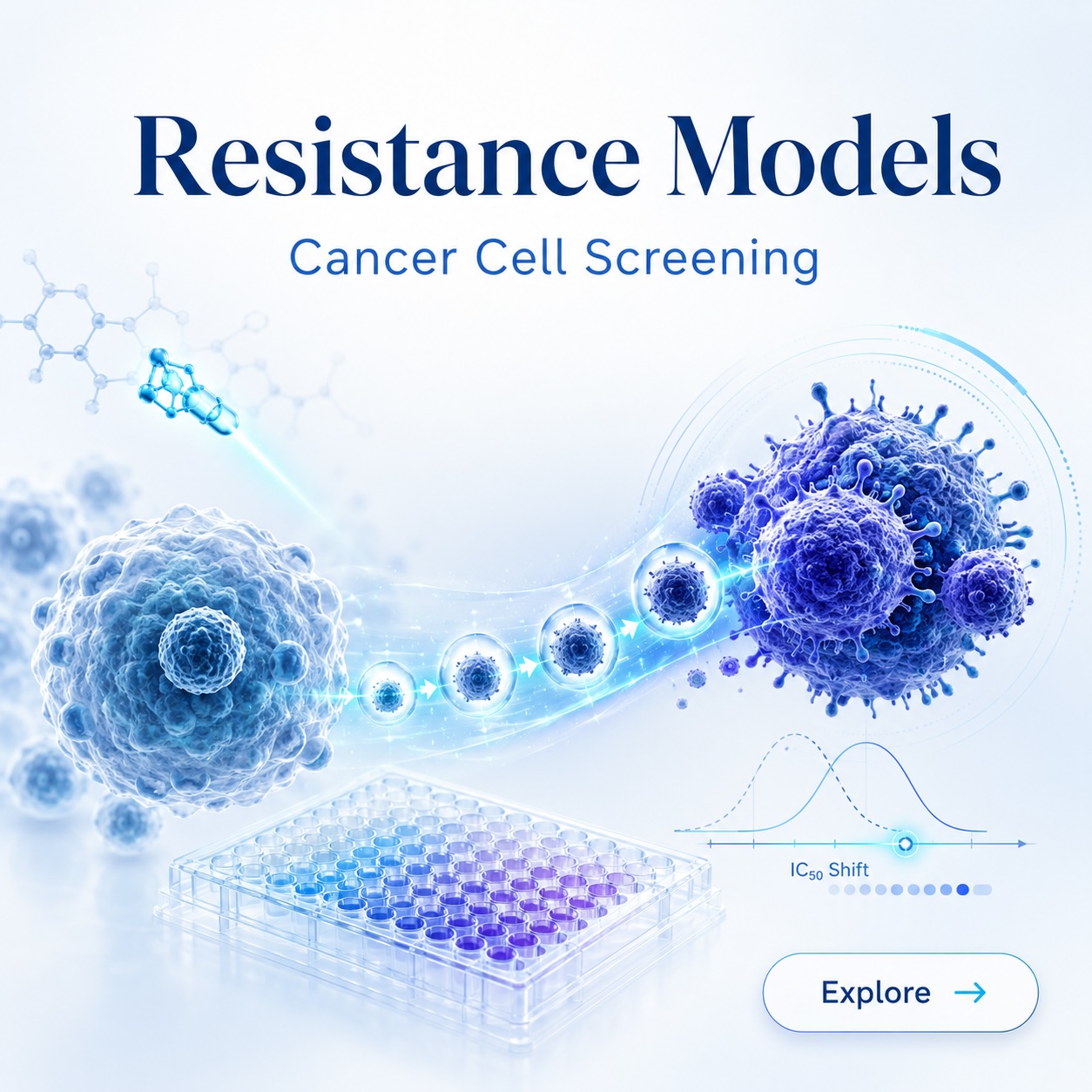
ADC/Payload Drug-Resistant Cancer Cell Line Screening

Establish and validate drug-resistant cancer cell models for evaluating ADC and payload response in an in vitro setting. Resistant sublines can be developed through continuous or stepwise selection, followed by resistance-index assessment, stability validation, and STR authentication.

The service also supports engineered models, including ABCB1 or ABCG2 overexpression and TOP1 mutation models, with optional RNA sequencing or whole-exome sequencing for mechanism-focused investigation.

Explore ADC/Payload Drug-Resistant Cancer Cell Line Screening ↗
ADC and payload drug-resistant cancer cell line screening
How the Studies Work Together
Development QuestionSupporting Service AreaDecision-Relevant Readout
Does the payload show the intended cellular activity?Payload screening and profilingMechanism-related activity, cytotoxicity, and cellular response
Does the ADC engage, internalize, and act in target cells?Antibody/ADC in vitro biologyAntigen expression, binding, internalization, trafficking, and cytotoxicity
Can released payload affect neighboring antigen-negative cells?Bystander-effect assaysDefined co-culture, imaging, flow cytometry, and reporter-cell assessments
Is the ADC stable and how is released payload processed?Non-clinical DMPKADC stability, DAR variation, released-payload metabolites, and bioanalytical support
Does activity translate in an antigen-defined tumor setting?ADC-focused CDX studies and resistant cell-line screeningControlled antigen-expression context, efficacy evaluation, and resistance-focused studies

Contact Us

We value your inquiries and are here to provide you with tailored solutions for your drug discovery and development needs. Whether you have questions, require more information, or are interested in discussing potential collaborations, our team of experts is just a message away.
Feel free to reach out to us.

We are a CRO service organization, not a hospital


Get a quote

Go top