
The in vivo drug-to-antibody ratio (DAR) value and drug load distribution on an ADC are crucial to the drug efficacy and safety. The evaluation of ADC stability in systemic circulation is usually achieved by characterization of free payload release rate and DAR value. During linker payload screening stage, the payload release rate showed the extent of linker cleavage in plasma, and the change of DAR value gave more information of deconjugation. The commonly used detection methods for DAR value were UV/Vis spectroscopy[2], hydrophobic interaction chromatography (HIC)[3], RP-HPLC[4], et al. Those methods were more compatible with samples with simple components instead of biological samples. There were many challenges in the analysis of DAR value by LC-MS in biological samples.
A highly specific and sensitive LBA-LC-MS method was successfully developed for the DAR value detection of Trastuzumab deruxtecan (T-DXD) in biological samples. The T-DXD was enriched by immunocapture with biotinylated antigen from human plasma and by anti-human IgG Ab from other nonclinical species plasma. After eluting the ADC from the immunocapture beads, 20 mM TECP was add to the elution; a Thermo QE Plus was used to detect the intensity of LC and HC. The intensity of the top three glycosylation HCs were summarized. The average DAR was calculated based on the summarized intensity. The results showed that the DAR values of T-DXD in mouse plasma sample after Day 0, 3 and 7 day incubation were 7.9, 6.8 and 3.6, respectively. The method had been used to evaluate both in vitro and in vivo ADC plasma stability. The workflow of the method can also apply to both conventional conjugated ADCs and site-specific conjugated ADCs, which could help researchers understand stability of ADC much better.

Covalent inhibitors are recognized as an indispensable parts in drug discovery and therapeutic researches. The irreversibility of covalent conjugation makes Liquid Chromatography-High Resolution Mass Spectrometry (LC-HRMS) a suitable tool for covalent inhibitor screening. LC-HRMS allows label-free, direct detection of the native protein and the covalent adduct in the sample, providing relative quantification of target engagement. Several methods have been developed for covalent screening using intact protein MS or peptide mapping, including binding site mapping, covalent binding rate determination and Kinact/Ki value measurement.
In this study, the final protein concentration was 1.5 μM and the serial concentrations of positive control AMG510 were from 0.49 μM to 4.00 μM, and the total incubation time was 100 seconds. The intensity of the native protein and covalent adducts were collected on a QE Plus coupled with a C4 column.
A relatively high binding rate was observed by intact mass analysis. And a sequence coverage of GDP-KRASG12C was above 75% using peptide mapping, the specific binding site was confirmed by MS2 data. Kinact/Ki value were fitted using more than six concentrations and five timepoints. This method was used for covalent inhibitors screening, binding site characterization and Kinact/Ki measurement.
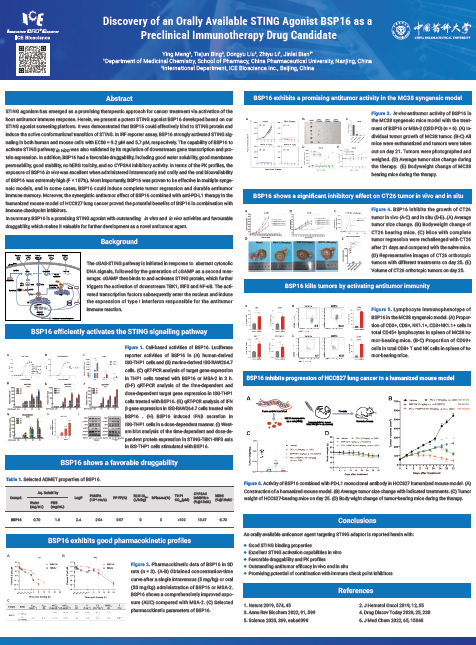
STING agonism has emerged as a promising therapeutic approach for cancer treatment via activation of the host antitumor immune response. Herein, we present a potent STING agonist BSP16 developed based on our STING agonist screening platform. It was demonstrated that BSP16 could effectively bind to STING protein and induce the active conformational transition of STING. In IRF reporter assay, BSP16 strongly activated STING signaling in both human and mouse cells with EC50 = 9.2 μM and 5.7 μM, respectively. The capability of BSP16 to activate STING pathway in vitro was also validated by its regulation of downstream gene transcription and protein expression. In addition, BSP16 had a favorable druggability, including good water solubility, good membrane permeability, good stability, no hERG toxicity, and no CYP3A4 inhibitory activity. In terms of the PK profiles, the exposure of BSP16 in vivo was excellent when administered intravenously and orally and the oral bioavailability of BSP16 was extremely high (F = 107%). Most importantly, BSP16 was proven to be effective in multiple syngeneic models, and in some cases, BSP16 could induce complete tumor regression and durable antitumor immune memory. Moreover, the synergistic antitumor effect of BSP16 combined with anti-PD-L1 therapy in the humanized mouse model of HCC827 lung cancer proved the potential benefits of BSP16 in combination with immune checkpoint inhibitors.
In summary, BSP16 is a promising STING agonist with outstanding in vitro and in vivo activities and favourable druggability, which makes it valuable for further development as a novel anticancer agent.
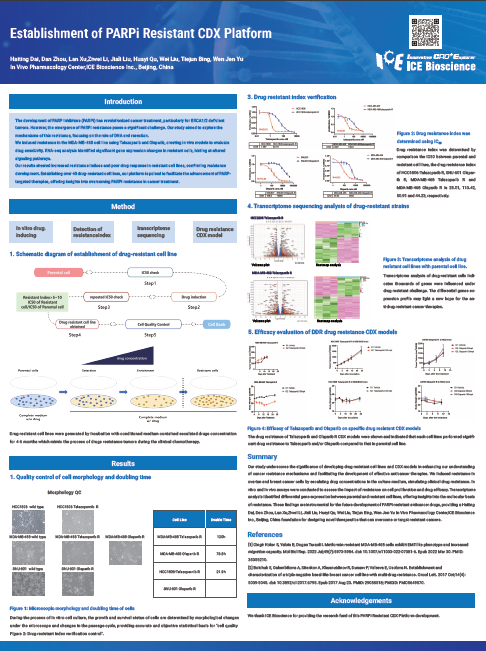
The development of PARP inhibitors (PARPi) has revolutionized cancer treatment, particularly for BRCA1/2 deficient tumors. However, the emergence of PARPi resistance poses a significant challenge. Our study aimed to explore the mechanisms of this resistance, focusing on the role of DNA end resection.
We induced resistance in the MDA-MB-468 cell line using Talazoparib and Olaparib, creating in vivo models to evaluate drug sensitivity. RNA-seq analysis identified significant gene expression changes in resistant cells, hinting at altered signaling pathways.
Our results showed increased resistance indices and poor drug response in resistant cell lines, confirming resistance development. Establishing over 40 drug-resistant cell lines, our platform is poised to facilitate the advancement of PARP targeted therapies, offering insights into overcoming PARPi resistance in cancer treatment.
Address: Bldg 16, Yd 18, Kechuang 13th St, Etown, Tongzhou Dist, Beijing, 100176, China
Email: marketing@ice-biosci.com
Tel:+86-10-67809840