
EN CN


Cell Based Assays

Return

NanoBRET Ternary Complex Formation Assays

The NanoBRET Ternary Complex Formation Assay is a live-cell method for studying ternary complexes formed by PROTACs, molecular glues, RIPTACs, and other multi-component systems. Using a NanoLuc luciferase donor and a HaloTag ligand fluorescent acceptor, the assay enables sensitive, real-time monitoring of complex assembly and interaction dynamics among three molecular components.

Principle

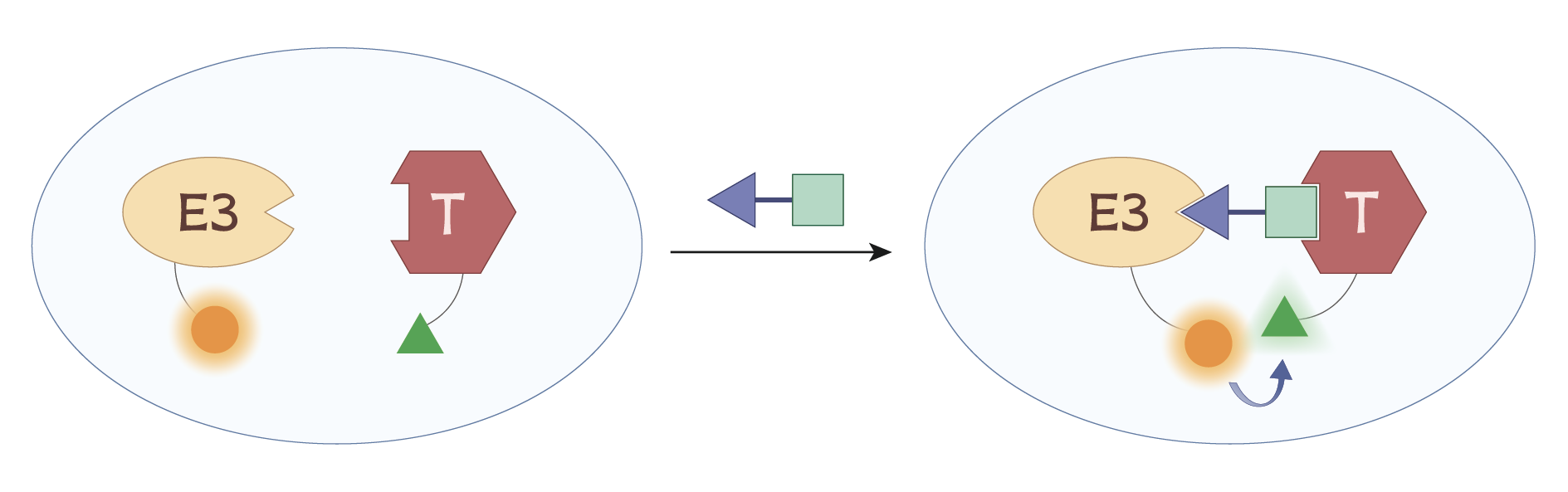
In a typical ternary complex system, a PROTAC or similar molecule bridges a target protein, such as a kinase, and an E3 ligase, bringing the two tagged proteins into close proximity. One protein is fused to NanoLuc luciferase, while the other is fused to HaloTag. When the third molecule promotes complex formation, the NanoLuc donor and fluorescent HaloTag ligand become closer, generating a measurable bioluminescence resonance energy transfer (BRET) signal.

The same principle can be applied to molecular glues, which promote or stabilize interactions between proteins that may not otherwise associate, and to RIPTACs, which are designed to redirect a target protein toward a second protein through induced proximity.

As ternary complex formation increases, the BRET signal becomes stronger. If the complex is destabilized or disrupted, the signal decreases. Signal intensity and concentration-response behavior can therefore be used to characterize the efficiency, potency, and dynamics of induced-proximity complex formation.

NanoBRET ternary complex formation principle

Applications
01

PROTAC Drug Discovery

Evaluate the ability of PROTACs to promote ternary complex formation between a target protein and an E3 ligase, supporting the characterization of induced-proximity behavior before downstream degradation studies.

02

Molecular Glue Discovery

Study how molecular glues induce or stabilize interactions between two proteins and compare concentration-dependent ternary complex formation across compound series.

03

RIPTAC Characterization

Assess induced proximity between a target protein and a recruited effector protein, helping characterize RIPTAC-driven ternary complex formation in live cells.

04

High-Throughput Compatibility

The assay is compatible with 96- and 384-well plate formats, making it suitable for screening PROTACs, molecular glues, RIPTACs, and other induced-proximity modulators.

Example Readout

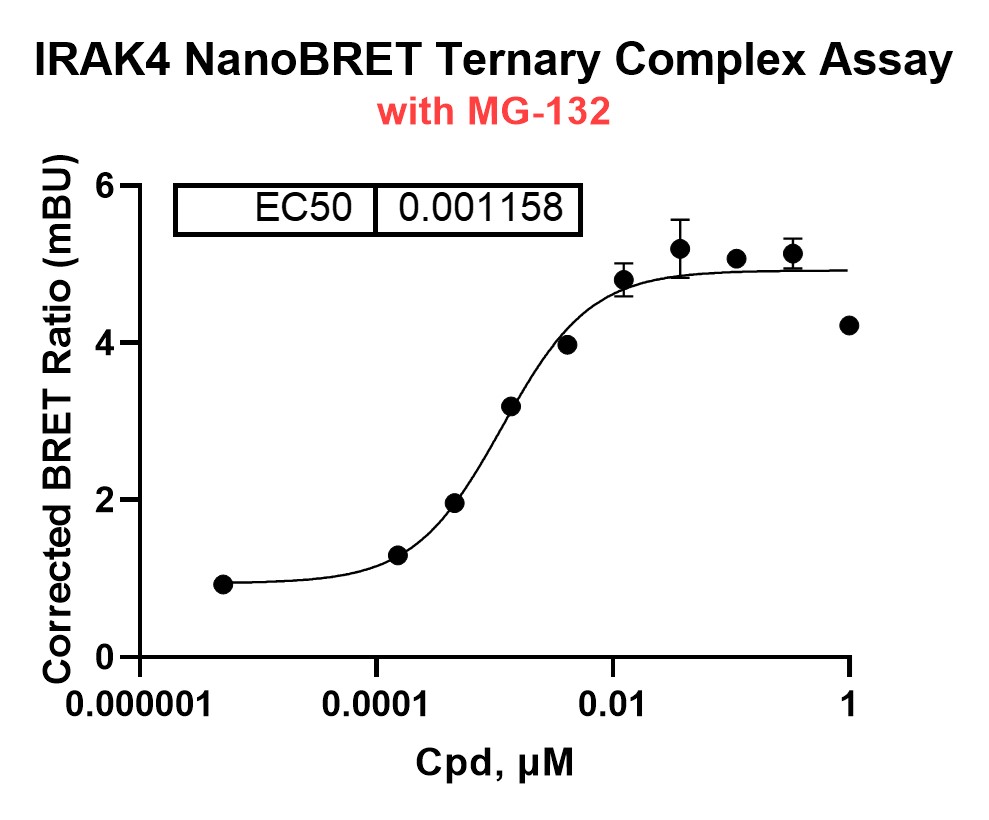
In the presence of MG-132, degradation of the target protein is inhibited. Under these conditions, a PROTAC may appear more effective at stabilizing the ternary complex, resulting in a lower apparent EC50. This readout helps distinguish complex formation from subsequent target degradation and supports a more complete evaluation of induced-proximity compounds.

NanoBRET ternary complex formation example readout


Contact Us

We value your inquiries and are here to provide you with tailored solutions for your drug discovery and development needs. Whether you have questions, require more information, or are interested in discussing potential collaborations, our team of experts is just a message away.
Feel free to reach out to us.

We are a CRO service organization, not a hospital


Get a quote

Go top